 LoupeLab
Cartier's Crash Skeleton: 150 Pieces of an Asymmetric Icon
Cartier introduced a new skeletonized version of the Crash at Watches and Wonders 2026, limited to 150 numbered pieces, exposing the in-house manufacture caliber while preserving the asymmetric melted-clock case shape that has defined the line since 1967.
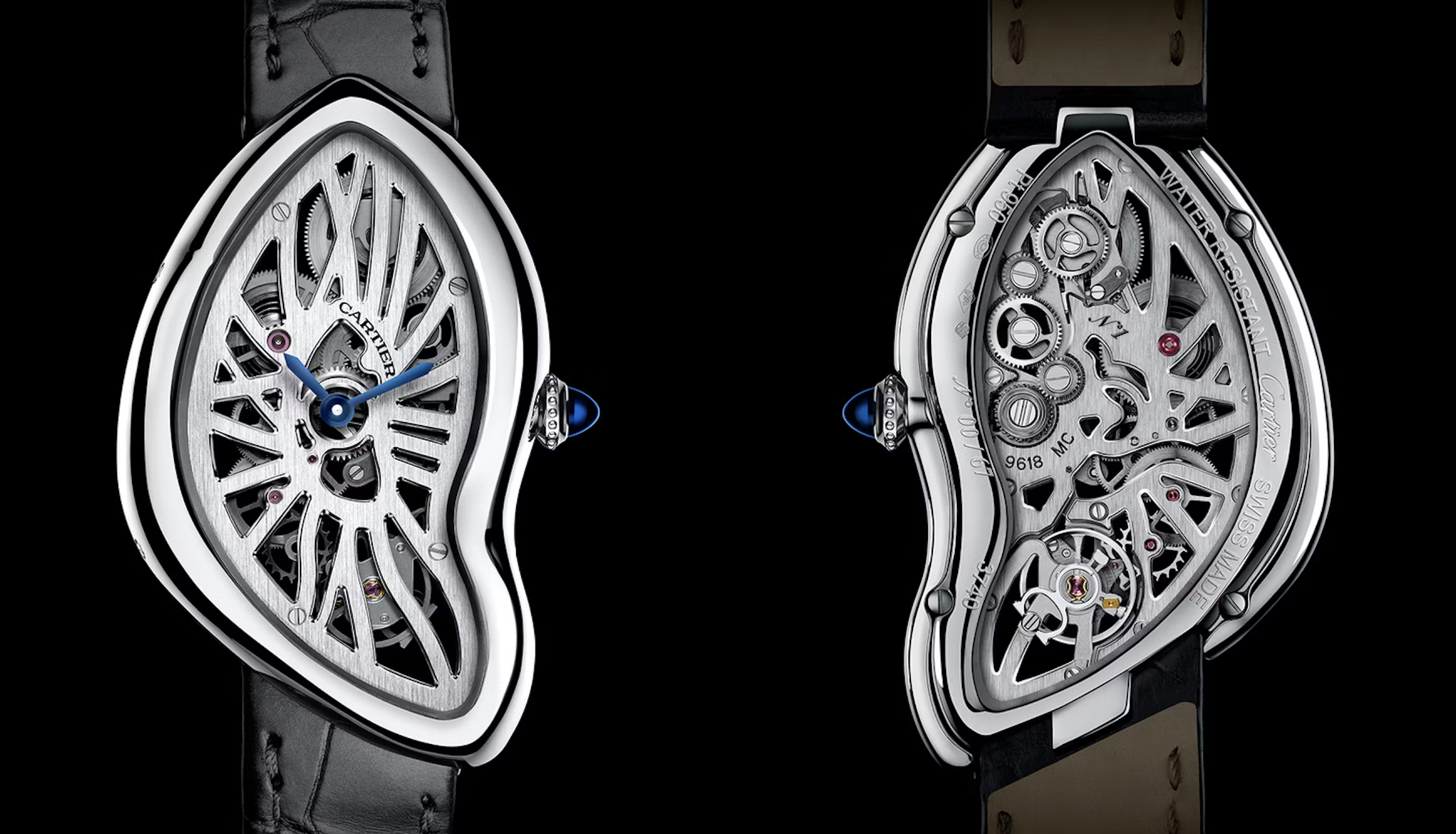
A Skeleton for an Asymmetric Icon
Cartier used Watches and Wonders 2026 to introduce a new skeletonized version of the Crash, limited to 150 numbered pieces. The release exposes the entire movement through an open architecture, with bridges shaped to follow the asymmetric case lines that have defined the Crash since its introduction in 1967. The case construction is in 18-karat gold, in keeping with previous Crash production.
The Crash Skeleton is not a new concept for Cartier. The brand produced an earlier skeleton variant in 2015 limited to 32 pieces, with subsequent small runs over the following years. The 2026 release expands the count to 150, larger than any previous skeleton run while staying within the boundaries of what Cartier considers a limited edition for the model.
Sponsored

Background: The Crash
The Crash first appeared in 1967 at the Cartier London boutique under Jean-Jacques Cartier. The watch carries one of the more colorful origin stories in horology. A popular legend holds that the design was inspired by a Cartier wristwatch damaged in a car accident, with the case warped by the heat of the fire. Cartier itself has never formally endorsed this account.
A more conservative explanation places the Crash in the context of 1960s surrealism, with reference to Salvador Dali's "The Persistence of Memory" from 1931 and its depiction of melting clocks. Whatever the source, the original 1967 production was extremely small. Since the 2010s, Cartier has periodically reissued the Crash in limited editions, and original examples now regularly sell at auction for hundreds of thousands of dollars. A platinum Crash crossed the block at Sotheby's for $1.5 million in 2022, setting a record for the model.
The Crash's Place in Cartier's Catalog
The Crash sits in a category of its own within the Cartier lineup. It is not a Tank, a Santos, or a Pasha. The asymmetric case shape, with its elongated and curved sides, is unlike anything else the brand produces. That shape demands a custom-formed movement, and Cartier produces calibers specifically for the Crash that follow the curvature of the case rather than the other way around.
The combination of a small production footprint, an unmistakable silhouette, and a movement built to fit only this case has made the Crash one of Cartier's most cult-followed references.
The Skeleton Treatment
The Skeleton version removes the dial entirely, replacing it with an open structure that reveals the movement underneath. The bridges of the manual-wind caliber are reshaped to follow the asymmetric case lines, creating the impression that even the mechanical components have been warped along with the case.
In keeping with Cartier's skeleton tradition, the Roman numerals are placed on the bridges themselves rather than on a separate dial element. The numerals stretch and curve with the bridge geometry, reinforcing the sense that every visible component has been built around the case shape.
The movement is a manual-wind caliber developed specifically for the Crash. Cartier has not disclosed full technical specifications for the 2026 reference, but the layout follows the established pattern for the model.
Why This Matters
Cartier's 2026 strategy emphasizes the brand's case design archive over movement innovation, and the Crash Skeleton continues that pattern. The technical story sits in the case shape and the way the movement bridges follow that shape, not in a new complication or a redesigned escapement.
The decision to expand the run from 32 pieces in 2015 to 150 in 2026 signals confidence in collector demand at this scale. 150 pieces remains small enough to preserve rarity but large enough that a meaningful number of clients will be able to acquire one through standard boutique channels rather than waitlists alone.
Pricing and Availability
Pricing has not been officially disclosed. Recent Crash Skeleton variants in non-anniversary years have priced in the range of $80,000 to $130,000 at retail, which provides a reasonable starting reference for the 2026 release. Allocation is expected to favor existing Cartier high-end clients with established purchase histories. The 150-piece run is intended to be distributed across Cartier's major boutique markets rather than concentrated in a single region.
Context: 2026 as a Cartier Year
Cartier had a strong showing at Watches and Wonders 2026 overall. Earlier releases at the fair included the Santos-Dumont mesh trio, the Myst, and revamped Roadster and Tortue lines. Across the lineup, the brand emphasized historical case shapes and bracelet construction over technical novelty. The Crash Skeleton fits squarely within that pattern. The watch remains a 1967 design with a skeleton treatment, presented for the 21st century without altering the silhouette that defines it.
Closing
The Crash Skeleton is one of those references where Cartier's strategy works best. The watch sells primarily on case shape and history, with technical execution providing supporting credibility rather than the lead story. At 150 pieces, the run is large enough to matter commercially without diluting the rarity that has driven the Crash's collector value to record levels at auction. For collectors who have been on Crash waitlists, 2026 may be the year a piece finally arrives.
Sponsored
More News
Watch Service in 2026: Realistic Timelines for the Major Manufactures
Service is the cost of ownership most new collectors underestimate. A practical guide to realistic service timelines and costs at Rolex, Tudor, Omega, Patek Philippe, Audemars Piguet, A. Lange & Söhne, JLC, and IWC, plus the authorized vs independent watchmaker tradeoff.
May 6, 2026
Richemont FY 2026 Preview: What to Watch When the Watch Division Reports
Richemont reports its full-year FY 2026 results in mid-May, covering the year that ended March 31, 2026. The mid-May report is one of the cleanest single reads of the year on European luxury watchmaking, and the commentary will set the tone for the second half of 2026.
May 6, 2026
How to Buy at a Geneva Watch Auction: A Primer for New Collectors
A practical walkthrough of the Geneva spring auction process at Phillips, Sotheby's, and Christie's — from catalog research and condition reports through registration, bidding methods, the buyer's premium, and post-sale logistics.
May 4, 2026
Raul Pages: The AHCI Maker Who Won the Louis Vuitton Watch Prize
In 2024, Raul Pages won the inaugural Louis Vuitton Watch Prize for Independent Creatives with his RP1 Régulateur à Détente, a wristwatch that uses a detent escapement rare outside of marine chronometers. His win is now a useful reference point for what AHCI membership actually means in practice.
May 4, 2026